Saturday, 5 October 2013

Sambaar Stories


Sambaar/Huli 


The Udupi restaurant outings of our childhood were very exciting but predictable. 

The excitement came from our fixed fare of a wada-sambaar, masala dosa, followed by a slab of ice cream. I surely must have exclaimed each time that I would love to eat this everyday. The waiters busily and expertly carrying several plates at a time, rarely spilling the sambaar, must have fascinated me. My eyes surely must have followed them, guessing which was our order, lighting up as I recognised our order coming up.

No wonder then, that I got teased. And that was the other thrilling factor - the ritual teasing – when the family would invariably and mercilessly tease me about marrying one of the waiters.

And did I love being teased! First of all, I thought it was a darned good idea to marry someone who worked in this exciting aromatic environment, daily serving dosas and wadas. 

My little mind could not have worked out the logistics of how I would have unlimited access to this stuff, or if the speculative husband would be able to actually cook this stuff. All I thought was - What fun!

Secondly, these prospective beaus my family teased me about (I was all of 6 or 7 years old) were invariably the good-looking Udupi waiters in their smart white uniforms and caps. What a bonus, I would think as I broke off a piece of the crispy dosa and shovelled some of the creamy potato masala onto it.

Years later, this scene was recreated in our favourite haunt, the Venus Udupi Restaurant in Muscat. We all had our favourite sequences of order; the only change ever would be if we ordered the thali. But not for our four year old, who was single-minded in her choice. One would have thought a little child would go for fried or sweet stuff. Or not go in for cooked food at all, like many of my friends’ fussy eater kids.

My youngest would invariably ask only for ‘sambaar-bhaat’. Now there was no such order option on the menu, and the first time on, just as we considered ordering a whole thali for her, our friendly waiter returned with a small plate of rice and a bowl of steaming sambaar. He had quickly gleaned her preference from our discussion and indulged with a smile.

When we got chatting, he told us in a hushed voice of how he and other young men of his ilk from that part of Karnataka made their way to the cities all over India to be employed in restaurants run by enterprising men of their community. If they were lucky, they would get to go overseas – the savings would be better, but their conditions of employment and even visa status would be even more suspect. The men left their families behind, so they could support them with almost all their earnings. After all they had really no expenses, they got their meals at the restaurant and got shoes and a pair of uniforms every year…

It was a revelation; not a very happy one.

But seeing the manner in which this particular person developed a bond with our little one over ‘sambaar-bhaat’ in the course of numerous subsequent visits, giving her that extra drizzle of melted ghee with a generous flourish, brought a lot of happy satisfaction.

The same sort of heartwarming satisfaction that hot ‘sambaar-bhaat’ brings in the tummy.


Sambaar/Huli Pudi (powder)

The sambaar/huli that my mother-in-law makes is exactly like the one that was served in this restaurant.

Happy to present her recipe for sambaar/huli pudi (powder).

Ingredients

¾ cup coriander seeds
1 tbsp chana dal (optional). You can use toor dal as well, but it gives a different flavour.
1 tbsp urad dal (optional)
1/2 tsp methi
1 inch long cinnamon stick
5-6 dried red chillies (or more)
A generous pinch of hing
½ cup desiccated coconut (optional)
1 tbsp oil

Method

Some families don’t use these two daals and some others don’t use desiccated coconut in the masala, preferring to use fresh grated coconut at the time of making the huli dish.

Heat a kadhai and add the oil. Add the coriander seeds, chana dal and urad dal, methi seeds and dried red chillies one after the other and roast until they turn golden brown and give out that savoury aroma. Add the hing and the desiccated coconut and switch off the heat, but keep roasting the masala. The heat is sufficient to toast the coconut a delicate brown. Cool the mixture and then grind it into a slightly coarse powder. Store in an airtight container.

My Huli or Sambaar

Ingredients

1 cup toor dal
2 cups vegetables chopped into largish pieces – I used green beans, bhindi (okra), carrots, pumpkin, potato and mooli (daikon). I didn’t have drumsticks, but they are also a must!
1 small / 2" piece of capsicum (this gives the huli a distinctive taste of the sambaar from Venus restaurant)
1 medium onion- chopped
1 large tomato –chopped
½ teaspoon tamarind concentrate (or more)
1 teaspoon jaggery
2 tablespoons grated coconut
1 tablespoon chopped coriander
7-8 curry leaves
3 tablespoons cooking oil
1 teaspoon ghee
1 teaspoon mustard seeds
2-3  dry red chillies, preferably the little round milagai chillies
A large pinch asafoetida
½ teaspoon turmeric
1½ tablespoon huli powder (see recipe above)
Salt to taste
Water

Method

Cook toor dal in a pressure cooker with 2 ½ cups water until soft. Mash the dal well. 

Heat a tablespoon of oil in a saucepan and add the onions and sauté them for a minute. Add the turmeric. Add all the vegetables, curry leaves and the huli powder and sauté for a few minutes so that the masala gets roasted in the oil along with the vegetables. Now add the tomatoes and cook until the tomatoes are soft and saucy. Add a cup of water, and let the mixture come to a boil. Now add the cooked dal, tamarind, jaggery, coconut and salt and adjust all tastes. Add more water to adjust the consistency you want, allowing for a bit of reduction after boiling.

When the huli/sambaar reaches a boil, turn the heat down and simmer for about 15-20 minutes, until the vegetables are cooked and stewed and the surface is frothy. Add a teaspoon of ghee, chopped coriander. 

Finish with a mustard seeds-hing, dry red chillies tempering (tadka) made with two tablespoons of oil. 


Serve hot with idly, wada, dosa, upma, uthappa  - and don’t forget – it’s the best with steamed rice and a drizzle of melted ghee.

Saturday, 28 September 2013

Just Falafel? Just saying…!

Falafels made by Amruta Nargundkar


The Robomaid ad on Facebook had followed me like a balloon man follows little children in the park. I think they have sensed that I am giving in.

My conspiracy theory is they are targeting anyone who has an interest in dogs and cats as pets and yearns for the mythical vacuum cleaner to the impossible.

Due to my foodie pursuits, Facebook’s “interest targeting options” suspect I have an eating disorder, and am desperate to try out Acai Berry, African Mango, Garcinia Clusiaceae, lap-bands and even hypnotic lap-bands.

Sigh. But I don't take offence.

No, not even when Kevin Rudd’s populist, swan song attempts to woo his electorate saw a surge of Australian government ads popping on my timeline. My telltale Indian/overseas born status must have attracted those ominous warnings that asylum seekers boats will be turned back.

Sigh again.

The latest in these ad-attacks, is the “Just Falafel” ad, exhorting me to  “Own my Just Falafel franchise in Melbourne” each time I log in.

I must confess I have clicked on the ad and find the idea absolutely tempting! Love the concept of a vegetarian falafel, an icon of Arabic cuisine, customised to suit various ethnic flavours.

I ask myself, do we have it in us to make our own renditions of masala wada, ambodey or daalwada falafels with some til chutney, chana dal dangar chutney, koshimbir salad and cucumber raita? All rolled up in a Lingayat jowar bhakri wrap or whole wheat phulka?

Do I have it in me to pander to the “business bug” yet again and slog away the next few of my dwindling years?

My Robomaid was delivered the other day. Does that mean this a portent for the falafel business?

Surely, there must be some special providence in why I see this ad all the time.

Perhaps the recent recognition our current education business has received makes me bold.

Or audacious?

Till I figure that out, let me tell you about the falafels my daughter Amruta made last weekend.

These are real authentic falafel – made with chickpeas as well as ful medames or fava beans. And the most delicious ones at that.

Amruta served them with homemade hummus, homemade tahini sauce, salad, and falafels with some fresh pita.


Falafels

Ingredients

1 cup dried chickpeas, soaked overnight
1 cup dried split fava beans, soaked overnight (optional)
1 medium onion, peeled and chunked
⅓ cup flat-leaf parsley, roughly chopped
½ bunch fresh coriander, roughly chopped
4 large garlic cloves
A pinch of baking powder (optional)
Salt to taste
1 tbsp Lebanese seven-spice powder (cloves, cumin, cinnamon, all spice (pimento), black pepper, white pepper, nutmeg)
Some red chilli flakes (optional)
Oil, for frying

Method

Drain and rinse the fava beans and chickpeas and put them in a food processor.

Add the onion, parsley, coriander, garlic, baking powder, salt, cumin and spice powder.

Add just a little water, if you must, and process until the mixture is into  a coarse dough. Transfer the ground mixture into a bowl.

In a wok or kadhai, heat oil. Shape the felafel mixture into small patty shapes and drop them into the hot oil and fry in small batches for about 2 minutes or until browned and crisp.

The Arabs use a cute little contraption to make perfectly shaped falafels that can be ejected into hot oil. But you can make falafels by hand.


Drain on kitchen paper and serve hot, with hummus, tahina, tzatziki, a side salad of shredded lettuce, sliced Lebanese cucumber, tomato and red onions.

Sunday, 22 September 2013

Sheera Indulgence – a fitting 150th blog post!

Gluten Free Rice Sheera - by Amruta Nargundkar


A doting father, my Baba indulged unembarrassedly in us when Aai, my mother went away for a week or two to her mother’s or on the few trips she went with her friends.

Baba would get as excited as us kids to be on our own, be able to eat out, watch movies, have no curfew time and do stuff that would usually not get past Aai’s approval.

One year Aai went on a short holiday to Pondicherry with three of her childhood friends at a very short notice. Baba was all game and helped her pack and be off on her way in a matter of hours, which was why we were left without the usual stock of “laadu-chivda” goodies, pre-prepped meals, any arrangements for a neighbouring “aunty” or the maid to come in and help braid my long hair and infinite and invariably forgettable instructions!

No sooner had she gone than I got sick from eating panipuri on the wayside “bandi” while returning from watching the “second show” of a movie on a school night. 

This level of indiscretion was possible only in Baba’s reign at home alone.

A day or two later, seeing that I had begun to miss Aai prematurely due to my sickness, Baba set about cheering me up by making my favourite sheera, for the very first time in his life. I was super excited and even offered to help, but he wouldn’t hear of it. All he asked for was the ingredients and I told him just that – the ingredients as I remembered them from hanging around the kitchen while Aai made the dessert. He didn’t ask me for the method and I didn’t tell him because I didn’t know it anyway.

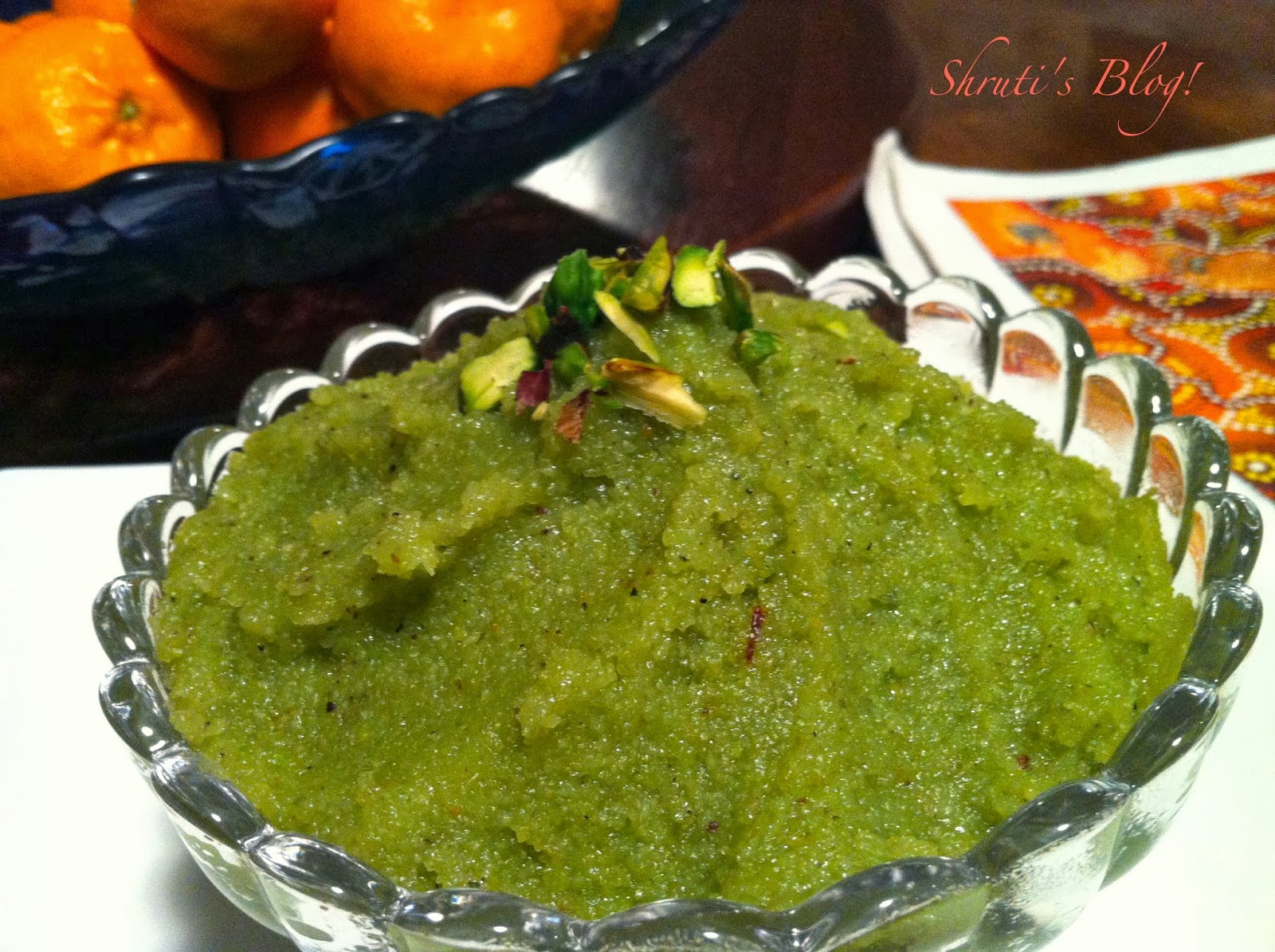
Then I sat back and waited impatiently for the aroma of roasted semolina that I, as the smelling scout, was required to watch out for and tell Aai I had smelt as a measure for the semolina’s doneness. Even as I was waiting for the whole house go agog with the aroma, Baba lovingly brought me a plateful of a green alien looking viscous mass.

Looking sheepish, he confessed that he had boiled water, added sugar, ghee and rava to create the flubber like sheera.  And since it looked un-appetizing he had embellished it with all the pistachio nuts in Aai’s secret stock in the pantry. When it still didn’t look good, he added some green food colour.

Although he wasn’t colour blind, he had broad-spectrum names for colours and flummoxed us with his descriptions – like the time he gave us instructions to launder his red trousers that were actually his brown pair.

At best Baba’s sheera could be described as “लय ” (homemade craft glue) or “लप्पम ” - mixed putty.  

And did he get teased for it!

Aai brought piles and piles of handmade paper, fabrics and incense sticks from the Sri Aurobindo Paper Factory and was eager to show us the brilliantly hued stuff- but even before we listened to the stories of her adventures, she first had to listen to the tale of Baba’s garish sheera escapade.

Life comes a full circle in the most unexpected ways.

When I was sick with a terrible cold some weeks ago and missing my mum, my first-born decided to make me some sheera. Warning me with dire consequences if I even got out of bed, she set about in the kitchen. The sense of déjà vu that descended even as I was presented with a plateful of sheera deepened when I saw the green colour.

What had possessed her? I had never used green colour in a sheera... and we hadn't talked about the lappum episode in ages...

But the sheera tasted great – certainly not like Baba’s lappum, but not 100% like Aai’s and my sheera either.

I spooned in a few mouthfuls trying to fathom how the fourth generation sheera is different. Watching my face keenly for approval, Amruta asked me in a deceptively casual voice where we stored the semolina. A little digging and it was confirmed that she has used idly rava made with boiled rice.

A new dish is created; a new family legend is born.


My Baba and his granddaughter who has never seen him surely concocted two diverse new confections – a cardamom flavoured craft glue and a gluten free sheera.

 But the common denominator is sheera indulgence …

Gluten Free Rice Sheera – by Amruta Nargundkar

Ingredients

1cup rice rava/ cream of rice
¾ cup sugar or Splenda
2 tbsp ghee
A pinch of salt
½ cup low fat cream
½ tsp cardamom powder
A pinch of saffron
2 tbsp chopped pistachios
A few drops of food colour of your choice (totally optional)  

Method

Heat ghee in a heavy bottomed pan and add the rice rava and roast on low heat till it turns a light golden colour. Add the cream and stir till it is absorbed. Add about two cups of boiling water and mix thoroughly. Cover and cook on medium heat for a few minutes till white steam emanates from under the lid.  Add sugar, cardamom powder, saffron (and food colour, if choose to) and mix.  Keep stirring till all the moisture evaporates and semolina is cooked completely. Remove from heat and rest the pan covered for a few minutes.

Garnish with chopped pistachios and serve hot.


Thursday, 12 September 2013

Modak Musings

Rava-Besan-Naral Laadu (रवा बेसन नारळ लाडू)
Photos by Amruta Nargundkar


“Aai, why does this calendar show Ganpati eating a laadu? Isn’t he supposed to eat modaks?” a young me unrolling a glossy brightly coloured wall calendar a shop assistant had very benevolently thrust into our shopping bag.

Receiving freebies is pleasurable even to kids, although one would think they wouldn’t know the difference of gratis and otherwise.  For someone who loved to receive even seemingly useless pamphlets and handbills so I could read them, the glossy colourful calendars depicting gods and goddesses, fluorescent sunsets - or even film stars-  was a treat. 

But I couldn’t understand why Mother was so wary of these loudly coloured wall calendars.  

Perhaps her aesthetic sensibilities and training wouldn’t allow her to patronise 'popular calendar art' ?

“Aga, the meaning of the Sanskrit word moda means 'pleasure or joy' and modak means 'that which brings pleasure or joy'…   a laadu - a primordial ball shape - also gives people joy and pleasure, so it is essentially a modak.  In the old days before grocery shops and supermarkets, people had easy access only to produce from the land they tilled. So they came up with their own versions of a laddu shaped sweet to offer to God. In regions where chana dal was grown, the laadus were besan or boondi laadus. In the coastal areas, where coconut and rice were the most commonly available ingredients, the coastal Maharashtrians must have devised laddus out of rice flour and coconut…”


I was busy looking at the tempting pile of laddus in front of the smiling Ganesh. That little mouse in the corner was nibbling at one, although the Lord hadn’t partaken of the offering – how could you do that! Even we kids had to wait until the Naiveyda was offered!

And how could the lord bear to wait patiently with the laddu in his outstretched hand for hours at end? I for one couldn’t rest until all the laadus in the large “pedheghati” steel dabba had been polished off, all the time wishing there were more and more and more...

When I look back, I realise Mother was a great one for explaining the meaning, etymology, significance, derivation, corruption, contractions and significance of everything, from words, rituals, superstitious practices, festivals, etc. etc.

I used to get impatient at times with her as a young girl, but now I realise what a treasure house of knowledge and wisdom she was, and still is.

I wish I could learn more and more from her.


Rava-Besan-Naral Laadu

Ingredients
2 cups rava (semolina)
1 cup laadu besan (grainy chickpea flour)
¾ cup ghee
1 ½ cups grated fresh coconut
3 cups sugar
1 ½ cups water
A pinch of salt
¾  tsp powdered green cardamom
A pinch of saffron
½ cup chopped almonds or cashew nuts
¼ cup raisins (optional – I don’t use them as my daughter hates them!)

Method 

Heat a large and wide thick-bottomed pan and add the ghee and besan. Roast the grainy ladu besan over medium heat till its light brown and starts to emanate a roasted aroma. I find this besan requires less ghee than the fine variety. Then add the semolina and a pinch of salt and roast for some more time until the mixture begins to look uniformly roasted. Add the chopped nuts towards the end and make sure to stir constantly so the mixture does not burn.

When the whole house is agog with the aroma of roasting besan and rava, add the coconut to the mixture and keep roasting for 4-5 minutes. You will notice the mixture will become suddenly very light and airy. Switch the heat off.

In another thick-bottomed saucepan, combine sugar and water and bring the solution to a boil. When the sugar dissolves and the syrup begins to thicken, drop some in a plate and test touch it with your forefinger. Then pinch the finger and thumb together and pull them apart. If the syrup strings out once forming a thread, the syrup has reached one string consistency.

Add the syrup to the roasted rava, besan and coconut mixture. Mix thoroughly and allow the mixture to soak in the syrup. Add the cardamom powder and saffron. Stir it from time to time. The mixture will become thick and crumbly in a while. Roll the mixture into laddus.


Store them in an airtight container, preferably in a self-replenishing pedheghati steel dabba.