Friday, 15 March 2013

Bananas 4 Bananas


Half and Half Banana Cake


The chef trainer has been waiting for me impatiently outside my office with some students in tow. In his anger he looks like Chef Skinner from the movie Ratatouille, his eyes flying in every-which-way in agitation. After a while, he looks more like Rumpelstiltskin, stomping his feet in frustration.

Without even knowing the reason for their strife, I begin to feel sorry for the students Chef has hauled up – simply because I empathise with them. It is indeed very difficult to keep a straight face - however culpable you are, whatever the gravity of your offence and however calamitous the consequences – when you see Chef’s eyes rolling in this way, one clockwise and the other quite the opposite.

I look at the defendants again, are they hanging their heads in shame and remorse, or to suppress their rascally grins?

It’s time to rush to their rescue. I adjourn my meeting and call them in. They all troop into the room, standing respectfully around my desk, heads still bowed. Chef starts describing the matter, and I flinch at his high pitch and heavily accented voice – he should have started on a lower note, I think. How is his voice going to sound in crescendo when his story reaches a climax?  

I am listening to him with full attention, but hear only nails on chalkboard.

And I avoid the boys’ eyes  – I must remember it’s hard to get out of a giggling fit.

It transpires that these students have been caught stealing bananas from the training kitchen.

Awww… I feel so sorry for the boys, studying in a foreign country, away from home for the first time in their young lives, missing their desi and rustic home cooked food, while learning to cook alien foods they haven’t ever seen, tasted nor developed a palate for.

“That’s very bad”, I say, forging as much severity as I can… “Please don’t do this again.”

“But - they ate up all four bananas and ruined my requisition for the practical class, now I have to postpone the session and put in another requisition…”

“That’s OK, chef, they won’t do it again.” I try to placate him…

“ Stealing is against our code of conduct” Another high pitched wail. I don’t need to be reminded – I wrote the code of conduct and rules, chef.

“Yes, so this is your first verbal warning. The next time will be your first written warning!”

Do I really subscribe to such pedantries?

“But do you know bananas are $12 a kilo after Cyclone Larry!” He persists in his persecution…

Any remaining disapproval dissipates, as I tell the boys to leave, not without an attempt at warning.

Then turning to tackle the tyrant, I tell him about how these young people are homesick, how although they are training to be cooks, they have never made a cup of tea for themselves in their lives before coming to Australia, how most of them can’t even afford to eat two square meals as it is so hard to find jobs in this foreign country – and no, they don’t want to ask their parents for more money than they have already raised to send them overseas.  

So what if they ate some bananas? They must have been tempted to steal them, as they couldn’t afford to buy what was probably the cheapest fruit in their country. Do we scold out kids so severely for helping themselves to goodies? As their quasi family we have an ethical and legal responsibility and pastoral duty…and from a customer service view, a few bananas is a small price to pay for goodwill…

Chef beats a hasty retreat, thinking I have gone bananas!

Did I tell you this ? I am a person, who by training and disposition, will never trash a single banana-gone-black, putting it away in the freezer till enough are collected to make something as tasty as this cake.

Half and Half Banana Cake


Ingredients 

1cup plain flour (maida)
1cup whole-wheat flour (atta)
1tsp baking powder
¼ tsp ground nutmeg
½ tsp ground cinnamon
¾ tsp salt
¾  cup oil
1 ½ cups sugar/sweetener
2 eggs
1 cup mashed bananas, very ripe – the blacker, the better!
¾ cup buttermilk (not too sour) + 1 tsp baking soda


Method

Preheat the oven to 180 C .

Grease and flour a bundt cake pan and set aside.

Combine flours, the baking powder, nutmeg, cinnamon and salt together in a bowl.  Mix and set aside.

Combine the buttermilk and the baking soda.  Mix and set aside.

Beat together the sugar and oil until light.  Add the eggs and beat until the mixture is light and fluffy.  Add in the mashed bananas and mix well.
Add half the flour mixture. Then add half the buttermilk mixture and stir well.  Then add the rest of the milk mixture and stir until the milk is fully incorporated into the batter.  Add the rest of the flour mixture and stir well.

Once the flour is mixed into the batter completely, pour it all into the prepared bundt pan.  Spread out evenly.

Bake in pre-heated oven for about 40 - 45 minutes. If your oven has uneven heat areas, turn the pan once half way through. Test with a skewer or if the cake springs back to touch, then it is done.

Cool for about 10 -15 minutes before cutting.


Thursday, 14 March 2013

Mindstickers


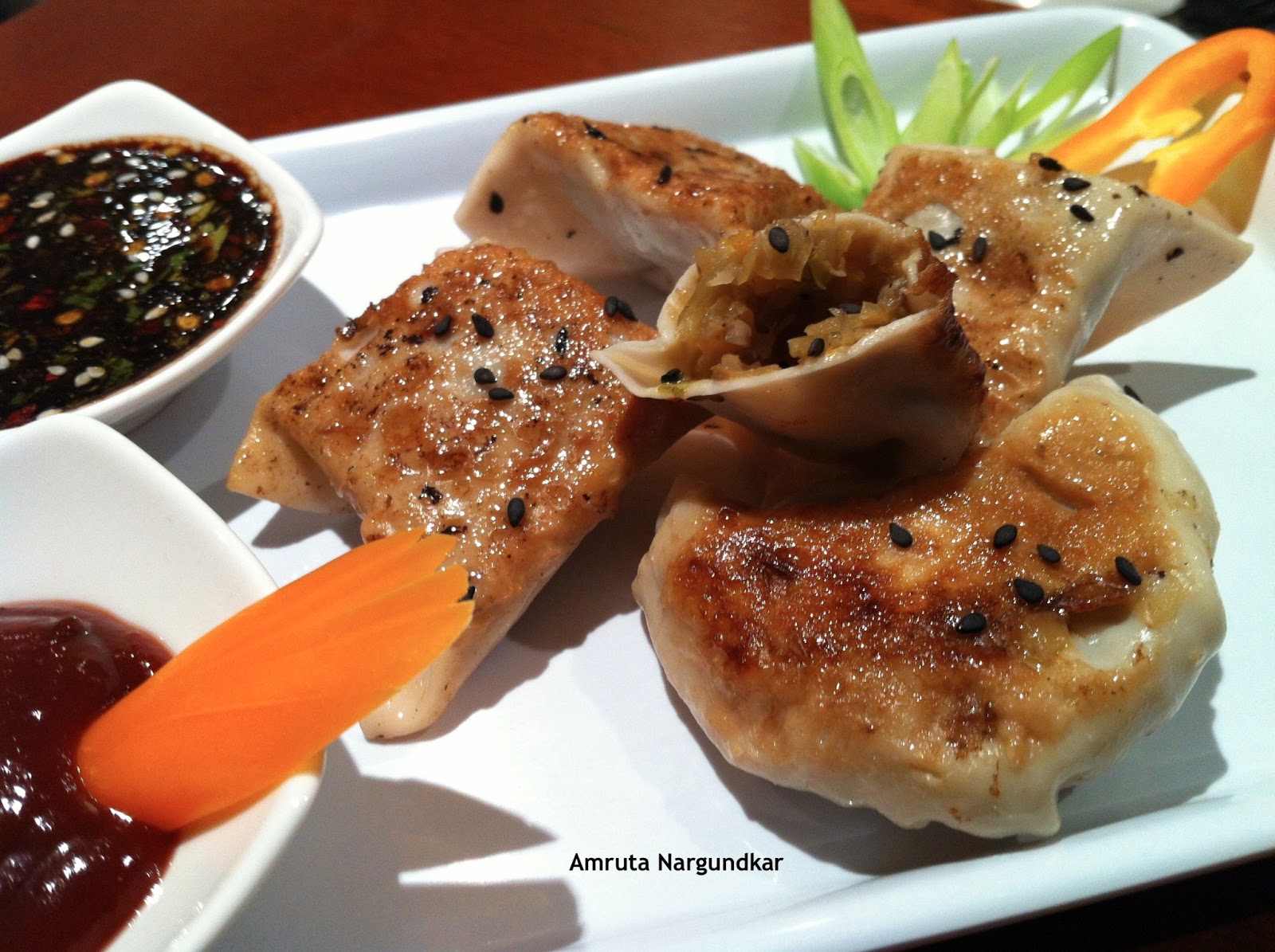
Vegetarian Pot Sticker Dumplings – by Amruta Nargundkar


Some things stick in your mind - and you have a hard time shaking them off.

A song you that you hear first thing in the morning - and actually hate.

Intrusive thoughts about what you’re going to do tonight – when you are writing the last exam for the year.

Potstickers you have very reluctantly and suspiciously bit into in a small dumpling place in China Town, at the behest of well meaning but momentarily untrustworthy friends -  and instantly get hooked onto to them!

This is what happened to Amruta Nargundkar when she was introduced to these unforgettable pot sticker dumplings.

Making them and getting them perfect the first time on - in the comfort (and safety) of her kitchen, Amruta quips, " A wary vegetarian gets a new and better appreciation of new cuisines, flavours and cooking techniques by cooking them at home!"

Can't agree more with you, my dearest daughter.  

Then, the mum in me has to say this- 

“Let this be a mindsticker - Cooking is more exciting and adventurous than eating!”


Vegetarian Pot Sticker Dumplings (by Amruta Nargundkar)

Ingredients

1 onion, chopped fine
1 tbsp minced ginger
1 tbsp minced garlic
1 cup chopped mushroom
2 cup white cabbage, shredded
1 cup carrot, shredded
½ cup spring onion, chopped
1 tsp white pepper
1 tbsp light soy sauce
1 tsp rice vinegar
1 tbsp sesame oil
1 tsp black sesame seeds
2 tbsp chopped coriander
1 package wonton skins, also called gyoza
Salt to taste
Oil
A pack of wonton wrappers


Directions

In a wok or large pan, add a little oil and saute onions, garlic and ginger. Add the sesame seeds to they get a little toasted in the oil and let out the flavour.
Add the mushrooms and stir. Add the cabbage, carrots and spring onions. Season with the soy sauce, vinegar, white pepper and salt.  Stir it a little more till it becomes dry. Add the sesame oil and coriander when mixture is cooled.
Adjust the tastes.

Using the wonton wrappers, make dumplings in whatever shapes you like, keeping the bottom flat.

Heat a medium sized wok/ non-stick pan and coat it liberally with oil.  Arrange 10-12 dumplings in the centre.  Watch carefully, and when the bottom of the dumplings get golden, add ½ cup of water and immediately cover with a high domed lid. This will steam the dumplings.

Carefully monitor the cooking of the dumplings and when the water completely evaporates let the bottom of the dumplings get crisp again.  The dumplings will now stick to the pot, justifying the name! 

Serve hot with a dipping sauce.


Suggestions for the dipping sauce – combine
4 tbsp soy sauce
¼  tsp garlic paste
1 tbsp dark soy sauce (sweeter than the thin soy sauce)
1 tbsp rice vinegar
Chilli flakes and sesame seeds
1 tsp sesame oil


Sunday, 10 March 2013

Genius Vs Genial


Hawaiian Pineapple Saar


Watching MasterChef Professional semi-finals on TV the other night and the much hyped lead-up to the (not so) scary chef Donovan Cook, we got talking about  chefs who find it necessary to yell and shout to get into the role. 

Oh yes, look at that Marco and even Ramsay…why do they need to holler so much!

It’s funny how in these days of an all-time-high-awareness of the importance of appropriate workplace relations, and of what constitutes workplace harassment and bullying, so many chefs get away with the shouting, yelling, bullying and terrorising behaviours.

First to jump to mind is the romanticised image of the chef as an artist whose creative idiosyncrasies are pandered to by staff and employers alike.  Insatiable in his or her pursuit for perfection, the chef should and must not accept mediocrity.

Well, let’s be fair, we perhaps have actually done a disservice to chefs by elevating cooking to the level of art and chefs as the lean, mean, exacting demigods - so why lament it when some chefs behave like dyspeptic and egoistic artists ?

In our quest for the genius have we lost the genial chef? 

The angry chef is as much a product of our pandering as he or she is of the harsh realities of working under pressure of service deadlines in hot and noisy kitchens, meeting contingencies, facing emergencies, coping with staff absenteeism and dealing with life-threatening accidents. 

Working weekend and late night shifts, facing occupational health hazards like cuts and burns, slips and trips on a daily basis and risking frozen shoulder, carpel tunnel syndrome, back problems and treacherous weight gain in the long term, perhaps make these people -who make others very happy- unhappy themselves.

Then the husband interjects, as he watches the chef admonishing someone in the team, “I am not sure if I would like to eat food prepared by this unhappy and stressed out bunch! And God knows how the chef’s minions must be getting their revenge... !”

I wonder where that “happy chef” concept has gone. The cherubic, plump face with the merry twinkle in the eye, lovingly leading kitchen teams and genially inviting you to partake of victuals…

I think I have just described my mother-in-law, who is another strong influence on my cooking, not just because I cooked alongside her and she taught me many dishes, but also by my vicariously learning from the reminiscences of her son, my husband. 

As a young girl who went to live with her in-laws, I had the most unconventional experience of being so warmly welcomed, loved and doted on by a new set of parents and a sister that I never had.  

We made a very efficient and effective team in the kitchen, my MIL - the genial chef de cuisine, I- the raring-to-go sous-chef, and my much younger SIL -the most energetic and diligent kitchen hand.

Our kitchen resounded with mirth as we joked, poked fun at each other and others, told anecdotes and gossiped and shared recipes. A most democratic MIL, mine would confer very cordially with me on menus, appreciate my cooking and very generously would teach me so many dishes.

Not just that, she enriched and added to lifelong trousseau of thrifty and nifty tricks and tips. And I have continued to add to this treasure by listening keenly to the husband describing his mother’s cooking and trying out her dishes.

Now in her late 70s, she’s slowed down a bit and doesn’t have to cook for an army like before, but is still enthusiastic about good food and ever ready to share a recipe.

When I phoned her the other day to get her recipe for her inimitable ‘saar pood’, she rattled it off from memory, leaving me scurrying for a pen and paper. Then again, she was keen to hear about the pineapple saar I made using the saar pood, and am sure she will give it a go one of these days!

Now, how many Chef De Cuisines will try out their Sous’ recipes?


Saar Pood (Madhavi Nargundkar’s recipe)

Ingredients


1 cup coriander seeds
3 tbsp cumin seeds
1 tbsp black pepper corns
1 tsp methi seeds (fenugreek seeds)
1 tsp mustard seeds
12-15 curry leaves
2-3 whole dry red chillies (or more)
¼ tsp hing
½ tsp turmeric
A little salt
1 tsp ghee

Method

Roast the coriander seeds lightly in a teaspoon of ghee.  Add the curry leaves at the start so that they will dehydrate by the end. Then add the methi seeds, pepper, cumin and mustard seeds. Break the chilli into small pieces and add to the roasted spice mixture. Add the hing, turmeric and salt to taste. Switch off the heat.

Cool and grind the mixture into a fine powder in a spice grinder.

Store in an airtight jar when the ground mixture cools.


Hawaiian Pineapple Saar

Do you remember the other day I made some pizza with pineapple? Well, on that day I had opened this large tin of pineapple loath as I am to throwing the juice down the drain, made this very Hawaiian Pineapple Saar.

Happy to continue the legacy of thrift...

Ingredients

2 cups light pineapple syrup (this is the juice in which pineapple slices come preserved in cans)
Alternately, you can use fresh or tinned pineapple blended with some water
2 tbsp chopped pineapple pieces
100 ml light coconut milk
1 tbsp saar pood (spice mix) or more
Lemon juice if required
Sugar/sweetener, if required
Salt to taste
A few curry leaves
A sprinkle of dried chilli flakes
About 1 cup water

Method

Combine the pineapple juice, a little water to dilute if it’s too strong, pineapple pieces and curry leaves in a saucepan and bring to a boil. Add the saar pood, a little salt, chilli flakes and the coconut milk.  Let it come back to the almost same temperature in a minute or so, without allowing it to boil (sometimes the coconut milk will curdle when boiled). Turn the heat off and adjust the tastes, adding the sweetener/sugar and lemon juice and salt as required.

Serve hot with soft rice and a nice curry and some papad. Alternately, you can serve it with a nice vegetable pulao or masaley bhaat.

Or, better still, serve as an aperitif or mocktail.

This is my 7th and last post bolstering my friend Preeti Deo's event -A Humble Giveaway to fight plagiarism.


Friday, 8 March 2013

Land Ahoy!


Masala Wada/ अंबोडे (crisp savoury lentil dumplings) 


“विकाराबाद आलं !” (We’ve reached Vikarabad) was a cry perhaps as dear to us as “Land Ahoy” to a weary sailor, for it marked a high point of the day-long train trip home from holidays.  

The journey till this point was arduous as we headed home, with laden feet and a heavy heart, after spending a memorable summer vacation with my maternal grandparents, cousins, uncles and aunts, stray dogs and cats that were house guests of the season - and mangoes!

Not that the train journey wasn’t fun – we monkeyed around climbing up and down the bunks, gingerly testing and almost pulling the stop chain, trying the switches of the quaintly funny Cinni fans and lights, sliding the windowpanes and shutters up and down, much to Mother’s chagrin.

But after a while we would tire of these games and begin to feel cooped up in the narrow gauge carriage, wooden bunks biting our bones, bits of coal from the steam engine fume plumes getting into our eyes, and the swaying when you closed your eyes would go away only after a whole day’s or night’s rest.

The only highlights so far (till Vikarabad, I mean, in case you lost me) would be the hot and sweet instant coffee Mother had bought us before boarding the train at Latur Road station, which was located many miles out of town and warranted a long bumpy bus ride. What was so great about coffee? Well, instant coffee was quite a novelty still, and (good) kids like us were not allowed coffee or tea.

The other highlight would be the lovely lunch Mai, our grandmother, had packed for us. This energetic lady would get up at 3 am to make our breakfast and pack lunch and dinner to last us on the journey. It would be fun to lay out our travelling lunch, open umpteen containers of the towering tiffin carrier and other sundry boxes of all sizes and shapes to discover the goodies.

धपाटी (theplas), à¤¤िखट मिठाच्या पुऱ्या ( masala pooris ) चुरम्याचे लाडू (churma laddu) soft chapatis and बटाट्याच्या काचऱ्या ची भाजी (crisp stir fried potatoes) गुळ-तूप, तूप-साखर (jaggery and ghee or sugar and ghee spreads) various pickles, hand pounded दाण्याची चटणी (peanut chutney)  and दहीभात (curd and rice) were usual, but each time they tasted better than before.

Now, we weren’t greedy kids, but somehow there is this inexplicable attraction for the forbidden – in this case the snacks and sweets - gul poli, gul-papdi cha ladu, chivda, sakhrparyachya vadya - Mai had packed for us in plastic bags and boxes in a wicker picnic basket covered with a tea towel and jealously guarded by Mother. Eat the fresh food now and keep the snacks for later - some sane but disappointing advice from her.

We would doze off after lunch, to Mother’s relief. To grant it to her, she had patiently answered all our questions so far (e.g. Do air planes also have toilets just like trains?) kept her temper when we whinged for the bright colourful lollies and peanuts from the vendor’s basket or squabbled over who would read which comics, scolded us for mimicking beggars singing and playing castanets, diligently, and we thought paranoidly,  told us not to touch this and that…

Waking up as we neared this town of Vikarabad, we would sight the huge rocky boulders, signboards that were now in Telugu and note excitedly that red buses gave way to green ones and black auto rickshaws of Maharashtra became yellow.

This point marked the entry into our home state Andhra Pradesh. It meant most of our journey was done. 

Sometime during the nap, our kid hearts had gotten over the sweet sorrow of parting and we woke up looking forward to going home, going back to school, buying new books, uniforms, school bags and shoes…

And the cry “विकाराबाद आलं !” revved up our spirits – for the ultimate reason – we would be allowed to buy the most delicious masala wadas at this railway station. Yes, buying food wrapped in old newspaper from vendors was a very exotic experience for us - and buying street food that met Mother’s strict quality control was an unbeatable and somehow unbelievable bonus.

As the train drew into the station with a little shed, we would fretfully look out for the vendor with the singsong nasal voice, wondering each year if it would be the same guy as the previous year, and if it was, would remember us…

Equally fretful were decisions about how many wadas to buy, with Mother giving in with each passing year in deference to our growing appetites and girths and quite simply, to our growing up. This was vindication of the yearlong misery of longing for these delectable morsels on roadside stalls and restrained by the strict prohibition.

Needless to say, the wadas - the most delicious, crisp, crunchy and tasty ones ever, would be gone even before the train left the station, but sated and happy, we would be too busy going at Mother -

“ Pleeeease, can I not get Dada’s hand-me-downs this year!”
" I need to wear pants from this year on..."
"Says who?"
"Says me.."


Masala Wada

The masala wada is a very popular savoury snack of South India and comes with many variations – with fennel seeds, with spring onions, with dill or mint, with turmeric or without, with or without garlic and ginger, round and flat ones, or round balls. Some use only chana dal, while others use a mix of chana dal, urad and moong dal.

As "Gateaux Piments" they are very popular in Mauritius, and as "Dal Wadas" they make very popular Iftar food in the Middle East.  

Marathi/Kannada versions go by the name ambode and are made especially for a festive meal. 

This is my sixth post in support of my friend Preeti Deo's event  A humble giveaway to fight against plagiarism.

And I am dedicating this post to the wonderful ladies in this story of my life- Mai and Aai! 

Ingredients

2 cups chana dal (Garbanzo beans)
½ cup urad dal (Black Gram)
½ cup moong dal (Green Gram)
1 large onion or 1 cup chopped green onions

1 tbsp chopped garlic 
1 tbsp chopped ginger
8-10 curry leaves
2-3 green chillies
2 whole red chillies (or more)
1 tsp cumin seeds
1 cup cleaned green coriander
Salt to taste
Oil to deep fry

Method

Pick, wash and soak the dals separately for a few hours.  Set aside a handful of soaked chana dal.  Peel and roughly cut the onion. Combine all the ingredients except the oil in a food processor bowl and grind coarsely using little or no water. Grinding in a food processor or onion chopper is necessary, as it allows you to grind without any water, unlike a mixer/grinder.

Remove the ground mixture in large bowl and adjust the tastes. Add the whole soaked chana dal. 

Try to shape a wada like a pattie with flattened sides in the palm of your hand. If the mixture doesn’t hold together, add a little besan (chickpea flour).

Heat oil for in a wok or kadhai. Test the batter by introducing a small amount pressed into a tight ball. If the mixture disintegrates in the oil, add some more besan.

Okay – let me gloat- I didn’t have to add any besan, as I ground the mixture without adding any water.

Make equal sized patties with thicker centres and thinner edges, and deep fry them on medium heat till golden and crisp. Remove on kitchen paper and serve hot with a chutney or sauce.